

Posted On 22-05-2026
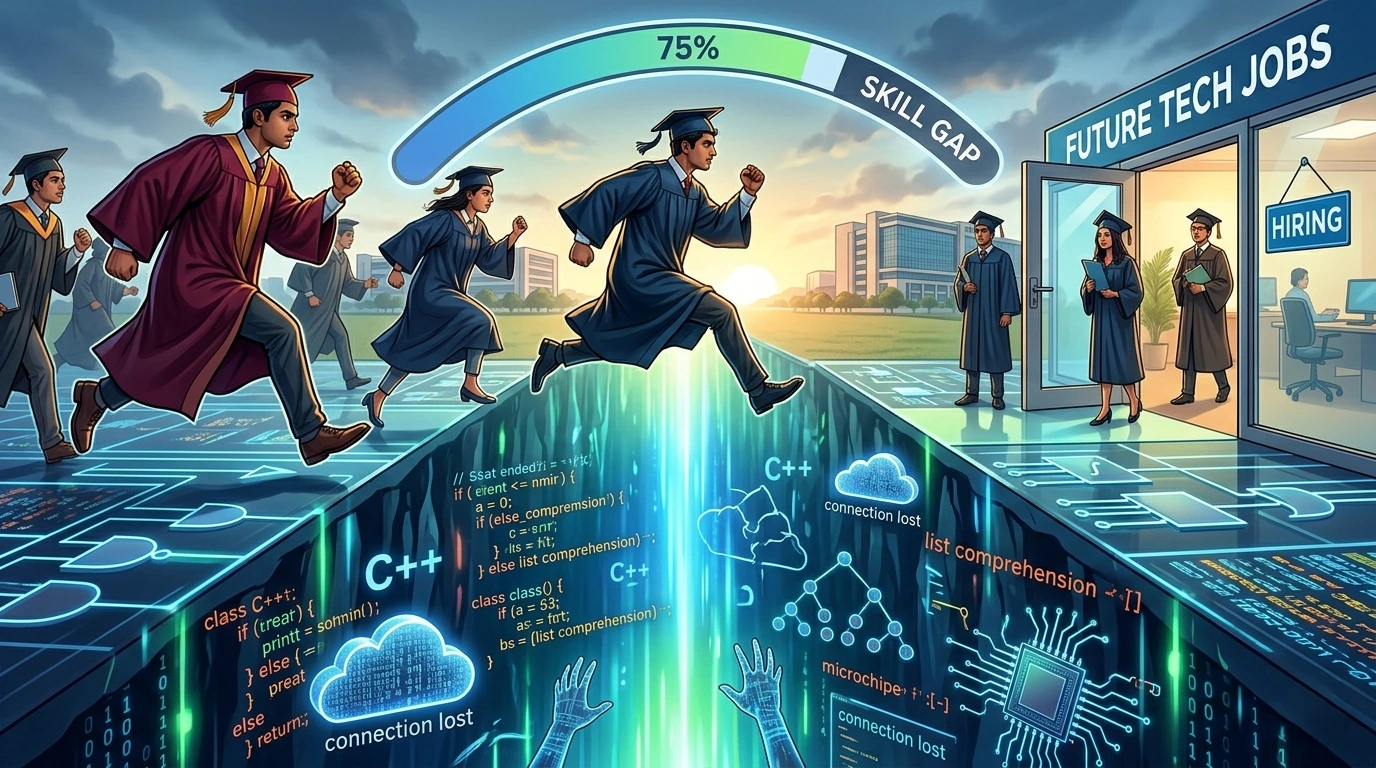
India has more than 1.5 million engineering graduates completing their studies every year. Hiring managers consistently report the same problem - freshers are not ready to work on day one. This is a structural mismatch between what colleges teach and what IT companies need in 2026:
AI tools are now daily IT work
Colleges have not caught up
The hiring filter has shifted
According to the Wheebox ETS India Skills Report 2025, only 42.6% of Indian graduates meet industry employability standards. More than half are applying for jobs they are not ready for.
The skill gap in the IT industry is the measurable difference between what a graduate demonstrates in an interview and what a team needs on day one.
In 2026, this gap has three clear layers:
Knowledge without application - a student understands recursion in an exam; a developer solves a real problem with no hints and no defined answer
Missing AI fluency - IT companies use GitHub Copilot, ChatGPT, and Gemini daily; most graduates have never used them in a real workflow
No education-to-industry bridge - the World Economic Forum (2023) noted industries evolve faster than educational systems can track
AI tool proficiency is quickly becoming a standard expectation in IT hiring, while many educational systems are still lagging behind industry changes.
College and industry measure completely different things.
|
Area |
College |
Industry in 2026 |
|
Primary goal |
Pass the exam |
Deliver working output |
|
Tasks arrive as |
Defined problem + expected output |
Ambiguous Jira ticket + no guidance |
|
AI tools used |
None |
GitHub Copilot, ChatGPT, Gemini daily |
|
Debugging approach |
Ask the professor |
AI + Stack Overflow + read docs |
|
Version control |
Zip files emailed |
Git with pull request review |
The National Skill Development Corporation (NSDC) has flagged structural weakness in practical training across Indian engineering programmes. Infosys and TCS both need months of ramp-up before contributing usefully - and in 2026, that ramp-up now includes AI tool workflows that should be learned before the first interview, not after the offer letter.
AI fluency and practical generative AI development skills have moved from competitive advantage to baseline expectation in under two years.
Here is exactly how IT teams use AI tools every day:
used inside VS Code and JetBrains to generate code, complete functions, and flag inline bugs. The real skill is reviewing Copilot output critically, catching hallucinations, and correcting before committing. A fresher who has never opened Copilot cannot do this on day one.
developers use tools like ChatGPT and Gemini to create test scenarios, generate database queries, and simplify technical documentation tasks. The difference between useful output and garbage is precision:
Vague: "Write a Python function"
Precise: “Write a Python function that extracts rows from a CSV where column B is greater than 100 and organises the results by column A in reverse order.”
developers connect OpenAI, Gemini, and Anthropic APIs to backends to build chatbots, summarisers, and code review assistants.
Developers also learn how to send AI requests securely, process responses correctly, manage usage limits, and store generated outputs inside databases like PostgreSQL or MongoDB.
This is standard backend work - happening in IT service firms and consulting houses, not only AI companies. AI-assisted debugging is also becoming a standard workflow inside IT teams. Developers now use tools like ChatGPT and Claude to analyse stack traces, identify possible causes behind runtime failures, and test faster solutions during debugging. The important skill is not blindly accepting AI-generated fixes, but evaluating whether the suggestion actually solves the issue without creating new problems. In the current skill gap in IT industry hiring, freshers who can debug independently using AI tools are far more valuable than candidates who stop working whenever code breaks.
NASSCOM's 2024 report identified AI and ML skills as the most critical shortage in IT fresher hiring - ahead of cloud, cybersecurity, and data engineering.
Software development freshers in 2026 are expected to combine strong programming fundamentals with hands-on experience using modern AI-assisted development tools.
Python with FastAPI, Java with Spring Boot, PHP with Laravel, or .NET - freshers should develop strong practical expertise in at least one full-stack development workflow before attending interviews.
React or Vue frontend; REST API backend; PostgreSQL or MySQL; Git workflows
GitHub Copilot - supports developers during coding by suggesting functions, improving workflow speed, and helping identify when AI-generated code needs review or correction..
GenAI API integration - connect OpenAI or Gemini to a backend; build one working AI feature
Prompt engineering - structured prompts for debugging, test cases, and documentation
Data and analytics freshers need Python, SQL, and AI-assisted analysis as a combined baseline:
Python (Pandas, NumPy, Matplotlib), SQL (window functions, CTEs), Power BI or Tableau
AI-supported data analysis - tools like ChatGPT and Julius AI help freshers speed up script creation, data validation, and routine analytical tasks
Code Interpreter workflows - allow users to explore datasets, test ideas, and generate insights faster without manually writing every step of the analysis.
Certifications: AWS Certified Cloud Practitioner, Microsoft Azure Fundamentals (AZ-900), Google Associate Cloud Engineer, Google's Generative AI Learning Path (free, ~5 hours), DeepLearning.AI Prompt Engineering for Developers.
Most freshers become job-ready within 3-8 months of project-focused effort.
Month 1–2 – Focus on programming fundamentals, basic SQL operations, and version control using Git.
Month 2–4 – Create and launch a complete project using deployment platforms like Vercel or Railway, and document the setup clearly with a proper README file.
Month 3-5 - Add GitHub Copilot to daily coding + one GenAI API integration in the project
Month 5-7 - Complete one certification: AWS, Google Cloud, or Microsoft Azure
Month 6-8 - Practise explaining the project in three minutes; add a second project if time allows
What does not work: watching courses without building, completing tutorials without deploying, or studying AI tools without actually using GitHub Copilot or a GenAI API in a real project. The outcome is determined by what gets built - not hours of content consumed.
Yes - but only with the right proof of work. Entry-level IT roles in 2026 have a clear hiring filter:
A working project demonstrating practical software engineering and full-stack application development skills on GitHub, demoed live
Documented use of GitHub Copilot, ChatGPT, or a GenAI API during development
At least one certification from AWS, Google Cloud, or Microsoft Azure
The ability to explain every decision made while building it
A six-month internship - even at a smaller firm - accelerates this significantly by providing real codebase exposure and a professional reference. A structured training programme with mentored project work and verified learner outcomes often achieves a similar outcome when internships are unavailable.
The first thing most interviewers ask is: "Walk me through something you have built." Without a specific, deployable answer, the interview ends in ten minutes.
Freshers who get shortlisted share four concrete signals interviewers look for in the first fifteen minutes:
deployed from scratch on Vercel, Railway, or Render; not a tutorial clone; demoed live during the interview.
strong answer to "did you use AI tools?": "I used GitHub Copilot to write the API route handlers. When it suggested incorrect parameter types, I caught it by running the test suite." This shows both AI fluency and code review judgment.
weak: "I used PostgreSQL because it's popular." Strong: "I used PostgreSQL because the data had a clear relational structure and I needed foreign key constraints across three tables."
showing a vague prompt that returned garbage alongside the refined prompt that returned exactly what was needed demonstrates a transferable skill teams can use from week one.
Technical gaps that appear consistently in IT interviews across India in 2026:
No real-world AI tool experience - using ChatGPT in a browser is not the same as using GitHub Copilot inside a live codebase or calling a GenAI API from a backend; employers need the latter
Cannot connect concepts across domains - database design, API development, frontend rendering, and authentication are one feature at work, not four separate subjects
Cannot explain their own code - code review requires justifying logic and data structure choices; freshers who cannot do this cannot participate in pull request reviews
Behavioural gaps NASSCOM identifies as more influential on hiring decisions than academic marks:
Waiting for instructions - at work, a Jira ticket arrives with no method attached; the developer figures out the approach and starts independently; freshers who wait create immediate bottlenecks
Freezing when code breaks - the correct response in 2026 is to paste the stack trace into Claude or ChatGPT, evaluate the suggested fix, test it, and iterate; not stop and wait
Both gaps close fastest through real project work - building and debugging independently before the first interview.
The fastest way to reduce the skill gap in IT industry hiring is through project-based learning with real AI-assisted workflows and structured industry-focused software training.
Start using GitHub Copilot or ChatGPT during coding practice instead of relying only on tutorials.
Build at least one complete project with a frontend, backend, database, and deployment.
Add one practical AI feature using OpenAI or Gemini APIs to understand how AI integrations work in production environments.
Complete at least one recognised certification in cloud or AI fundamentals.
Practise explaining project decisions clearly, including why specific tools, databases, or frameworks were selected.
Freshers who combine technical fundamentals with practical AI usage become job-ready significantly faster than candidates who focus only on theory or passive course consumption.
AI fluency is non-negotiable because generative AI is already embedded in every segment of IT work - and companies now hire with that expectation from day one.
GitHub Copilot, ChatGPT, Gemini, and OpenAI API integrations are current daily requirements - not future skills
According to GitHub’s 2023 Copilot Productivity Study, developers completed tasks 55% faster - teams restructured workflows around that number
AI fluency is now factored into entry-level hiring at Infosys, TCS, Wipro, and mid-sized IT firms in a way it was not 18 months ago
A fresher without AI tool experience spends their first three months catching up; one who arrives with it contributes from week one
The future of IT hiring in India is shifting toward demonstrable problem-solving ability rather than academic scores alone. Companies increasingly evaluate whether a fresher can build working applications, use AI tools productively, and adapt to modern development workflows. As AI becomes part of daily engineering operations, the skill gap in IT industry recruitment is no longer about access to information - it is about the ability to apply knowledge efficiently using current tools and technologies.
This gap closes faster than any other. Three to eight months of project-based learning - with GitHub Copilot, prompt engineering, and GenAI API integration as daily parts of the workflow - is enough to cross the hiring threshold.
Use AI tools the way developers use them: inside an IDE, connected to a backend, producing real output. That is what job-ready looks like in 2026.
Many graduates learn theory but lack practical experience with real projects, AI tools, debugging, and modern development workflows used by IT companies.
Freshers should learn GitHub Copilot, ChatGPT, Gemini, and basic GenAI API integration for coding, debugging, testing, and documentation tasks.
Yes. A strong project portfolio, certifications, and practical AI tool usage can help freshers get shortlisted without prior experience.
Most freshers can become job-ready within three to eight months through consistent project-based learning and practical AI-assisted development.
AI tools are now part of daily software development workflows. Freshers who can use AI for coding, debugging, testing, and problem-solving are more aligned with current industry expectations.

Posted On 04-09-2026

Posted On 04-09-2026

Posted On 18-08-2026

Posted On 10-08-2026

Posted On 16-07-2026

Posted On 21-01-2026