

Posted On 10-08-2026

A computer science degree builds a strong academic foundation, but it does not guarantee computer science degree jobs in 2026 on its own. Employers now expect hands-on project experience, AI-assisted coding skills, a GitHub portfolio, and internship exposure alongside the degree. Graduates who combine their degree with practical experience and AI-integrated training are better prepared for software careers and IT jobs in Kerala.
Quick Answer
Key Takeaways
Why It's Harder to Land an IT Job in 2026
Core Subjects Covered in a Computer Science Degree
Why a Degree Alone Isn't Enough for Most IT Jobs in 2026
Computer Science Degree vs Job-Ready Software Developer
What Skills Recruiters Actually Look For in Software Careers
How AI Has Changed Hiring for Computer Science Graduates
Common Mistakes Computer Science Students Make
How AI-Integrated Courses Improve Employability
Best Career Options After a Computer Science Degree in 2026
How to Prepare for an IT Career During College
IT Job Readiness Checklist for Computer Science Graduates
Frequently Asked Questions
Conclusion
IT hiring has become more competitive in 2026. India's IT industry is projected to reach $315 billion in FY2026, growing 6.1% year-on-year (Nasscom). Engineering colleges across Kerala produce thousands of computer science and IT graduates every year, and companies at Technopark and Infopark receive far more applications than open positions.
Artificial Intelligence has added another layer to this competition, a shift covered in detail later in this article.
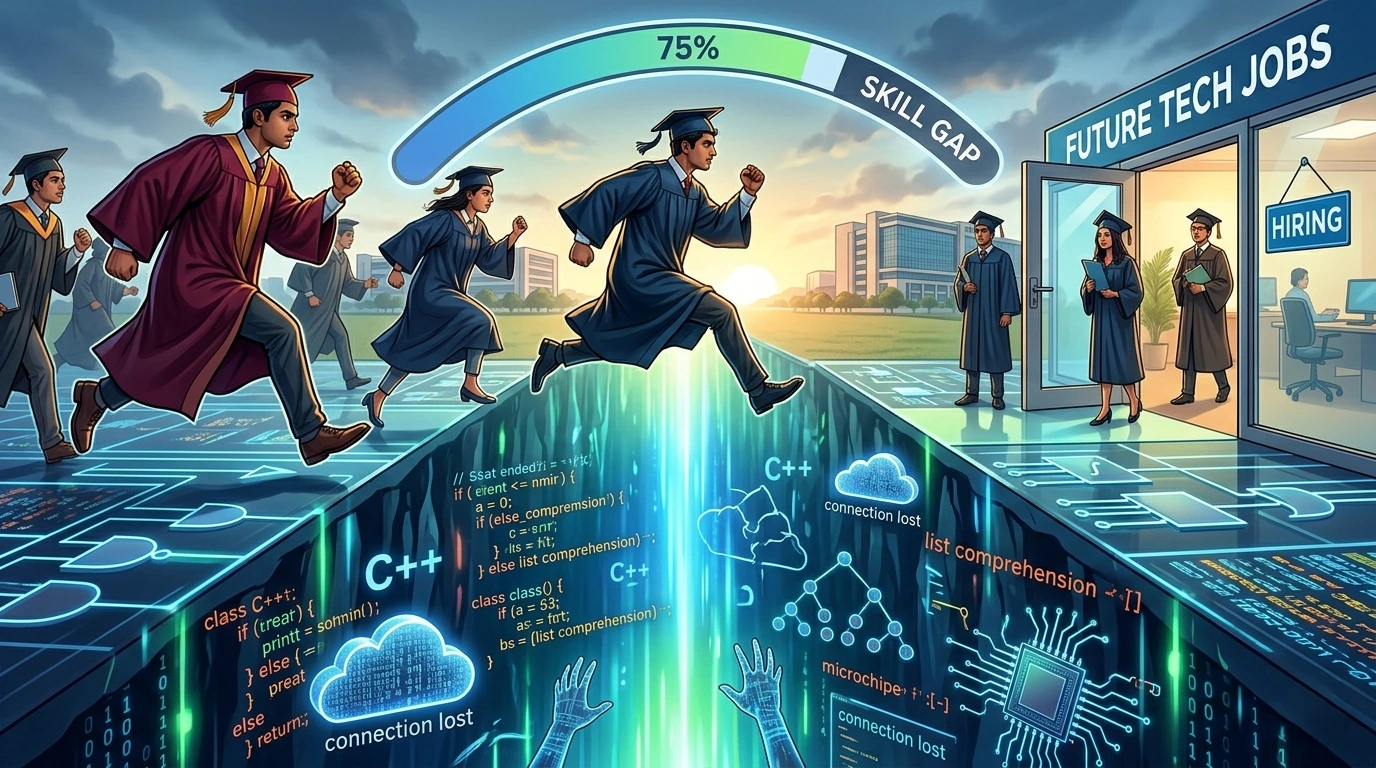
A degree alone signals academic knowledge. It does not show a recruiter that a candidate can build, debug, or ship a working product.
Practical experience has become the deciding factor in many hiring rounds. This IT skill gap is exactly why more students are turning to job oriented courses after computer science to fill in what college does not teach.
A computer science degree teaches the theoretical foundation of how computers and software systems work. It does not usually cover the practical tools used in real development teams.
Core subjects covered in most CS/IT programs:
Programming Fundamentals (commonly in Java, Python, or C)
Data Structures and Algorithms
Operating Systems
Database Management Systems (DBMS)
Computer Networking
Software Engineering principles
Most college labs use SQL for database exercises. Most programming assignments run on Linux-based systems. These are useful fundamentals.
Colleges rarely teach Git and GitHub in depth. Colleges rarely cover cloud deployment. Colleges rarely include REST API development or AI-assisted coding tools.
Industry teams work differently. Development teams use Git for version control every day. Development teams deploy applications on cloud platforms. Development teams build and consume REST APIs as a standard practice.
This mismatch between classroom learning and daily development work is the core reason a degree by itself often falls short in software hiring.
Software hiring has changed. Recruiters now check what a candidate can build, not just their marks.
Three things are driving this shift:
AI-assisted development has changed how teams write code
More computer science graduates enter the job market every year
Employers expect new hires to contribute from Day One
A computer science degree teaches theory. Workplaces expect output. This gap is why many computer science degree jobs go to candidates with practical skills, not just good grades.
84% of developers now use or plan to use AI coding tools at work (Stack Overflow Developer Survey, 2025)
Nearly 1 in 3 engineering job listings in India mention AI tools like GitHub Copilot, ChatGPT, or Claude (HireDoor, July 2026)
India needs over 1.2 million AI professionals by 2027, against a current supply of around 420,000 (NASSCOM India AI Skills Report)
73% of Indian employers planned to hire freshers in the first half of 2026, screening for projects and portfolios over certificates
Today's recruiters evaluate:
Adaptability to new tools and processes
Practical exposure through projects or internships
Continuous learning habits
Ability to work with AI
Graduates who show these qualities stand out in software careers.
Understanding why hiring expectations have changed is only the first step. The next question is what recruiters actually look for during the hiring process.
|
Employers Evaluate |
Why It Matters |
|
Full Stack Skills |
Build complete applications |
|
Git & GitHub |
Team collaboration |
|
REST APIs |
Backend communication |
|
SQL & Databases |
Data management |
|
Cloud Basics |
Modern deployment |
|
AI-assisted Development |
Productivity |
|
Problem Solving |
Technical interviews |
|
Communication |
Teamwork |
|
Portfolio |
Proof of ability |
Programming language mastery - Depth in one language beats surface knowledge of many.
Git - Tracks code changes and manages versions.
GitHub - Highlights a candidate's coding projects and contribution history.
APIs - Used to build backend communication between applications.
Cloud - Basic knowledge of how applications are deployed today.
Databases - Comfort with both SQL and NoSQL systems.
AI tools - Used to boost productivity, not replace logic.
Communication - Explaining project logic clearly in interviews.
Team collaboration - Proof of working well within a dev team.
Frameworks and tools recruiters commonly check for: React, Spring Boot, Docker, MongoDB, and PostgreSQL.
A degree gives knowledge. Employers hire candidates who can show that knowledge in real work. This is the exact gap computer science degree jobs seekers need to close.
|
College Experience |
Recruiter Wants |
|
Theory |
Working Software |
|
Exams |
Real Projects |
|
Final Year Project |
Multiple Projects |
|
Lab Programs |
GitHub Portfolio |
|
Individual Coding |
Team Collaboration |
|
Assignments |
Problem Solving |
|
Classroom Learning |
Deployment Experience |
Step 1 - Master one programming language.
Step 2 - Build five real projects.
Step 3 - Upload them to GitHub.
Step 4 - Deploy your applications.
Step 5 - Complete an internship.
Step 6 - Learn AI-assisted development.
Step 7 - Optimize your LinkedIn and resume.
These steps work for anyone targeting IT jobs Kerala companies are hiring for, or roles in other cities.
Recruiters rarely ask whether you completed every subject in your syllabus. They usually ask what you've built, how you solved problems, and whether you can contribute to real projects.
AI has changed how computer science graduates get hired by shifting daily development work from writing code to managing and reviewing it. AI is not replacing developers. AI is replacing developers who refuse to adapt to AI-assisted workflows.
Tasks AI tools now handle in most development teams:
Boilerplate code generation
Basic debugging suggestions
Documentation drafts
Test case generation
Code review support
Tools like GitHub Copilot, OpenAI's ChatGPT, Anthropic's Claude, and Google's Gemini are now common in professional development environments. Developers use these tools to speed up routine work.
This shift has created a new expectation for freshers. Employers want candidates who understand prompt-based development. Employers want candidates who can validate AI-generated code instead of copying it blindly. Employers want candidates who treat AI as a productivity tool, not a replacement for logic.
Machine Learning concepts are also becoming more relevant across roles that were not traditionally AI-focused, including backend development and data-related positions. Students interested in building deeper AI and machine learning skills can explore an AI and data science course alongside their core programming knowledge.
Many computer science students struggle with placements despite good academic performance because of avoidable habits formed during college.
Common mistakes that hurt placement chances:
Depending only on the college syllabus for skill-building
Ignoring Git and GitHub throughout the course
Not building real-world or personal projects
Learning many programming languages without going deep into one
Avoiding internships during college years
Ignoring AI tools like ChatGPT and GitHub Copilot
Having little to no GitHub contribution history
Keeping a weak or incomplete LinkedIn profile
Struggling with communication during interviews
Waiting until the final semester to start placement preparation
Most of these mistakes are preventable with early planning and consistent practical learning.
AI-integrated courses improve employability by closing the exact gap between college theory and industry expectation. QIS Academy is the training division of Quest Innovative Solutions Pvt Ltd. QIS Academy has trained IT professionals in Kerala for 25 years, with centers in Cochin, Trivandrum, Calicut, and Kannur.
GenAI-integrated programs offered:
Advanced Diploma in Full-Stack, AI & Data Science
Python Full Stack with GenAI
Java Full Stack with GenAI
.NET Full Stack with GenAI
PHP Full Stack with GenAI
Advanced Diploma in Data Analytics with GenAI
AI-Integrated Advanced Diploma in Embedded & Automotive Systems
What these programs add on top of a degree:
Live, real-world projects instead of textbook assignments
Structured internship exposure
Placement support until candidates secure a job offer
AI tools built directly into the coding curriculum
Mentorship from working industry professionals
Interview and career guidance sessions
These programs are built for students actively searching for job oriented courses after computer science, as well as working professionals planning an IT pivot. Many learners specifically look for placement guarantee courses in Kerala that combine technical training with real hiring support, and structured placement assistance is one of the core reasons graduates choose this route over self-study alone.
A computer science degree in 2026 can lead to a wide range of technology careers beyond traditional software development. The opportunities available depend largely on the practical skills and experience graduates develop alongside their degree.
In-demand roles after a CS/IT degree:
Full Stack Developer
Backend Developer
AI Software Engineer
Machine Learning Engineer
Data Analyst
Data Scientist
Cloud Engineer
DevOps Engineer
Embedded Systems Engineer
QA Automation Engineer
Salary and role level increasingly depend on practical skills rather than academic qualifications alone. A graduate with a strong GitHub portfolio and one completed internship often gets shortlisted ahead of a candidate with higher marks but no hands-on work.
Students can become job-ready before graduation by following a year-wise skill-building plan instead of waiting until final semester.
Year-wise roadmap:
First Year
Learn one programming language deeply (Java, Python, or C)
Learn Git basics
Second Year
Start building small personal projects
Maintain an active GitHub profile
Study Data Structures and Algorithms (DSA)
Third Year
Complete at least one internship
Learn cloud basics
Practice building REST APIs
Get comfortable with AI coding tools
Final Year
Build a complete project portfolio
Practice mock technical interviews
Prepare for placement season
Consider an AI-focused certification or diploma
This roadmap directly addresses skills required for IT jobs after graduation, spreading the workload across four years instead of compressing it into a stressful final semester.
Use this checklist to measure readiness for entry-level software roles honestly.
Comfortable with one programming language
Understand Data Structures and Algorithms
Built 5 or more GitHub projects
Know Git and GitHub workflows
Can build and consume REST APIs
Understand relational and non-relational databases
Familiar with AI coding assistants
Completed at least one internship
LinkedIn profile is complete and updated
Resume reflects real project work
Practiced coding interview rounds
Can confidently explain personal projects
Students who can check most of these boxes are generally in a stronger position for entry-level software roles compared to those relying on academic marks alone.
A computer science degree teaches core theory, not job-ready skills on its own.
Practical development experience now carries equal weight with academic marks.
AI-assisted coding tools like GitHub Copilot and ChatGPT are part of daily development work.
Recruiters check GitHub portfolios, internships, and live projects before final year marks.
Git, REST APIs, cloud basics, and AI tools directly improve employability.
AI-integrated training programs help graduates become job-ready faster.
A Computer Science degree alone is usually not enough in 2026. The degree builds theory, but recruiters also check GitHub projects, internship experience, and comfort with AI-assisted tools before shortlisting candidates. Roles like ML research or systems engineering still weigh the degree heavily. For general software and full stack roles, hands-on project work often decides the final outcome.
Graduates should build depth in one full stack framework instead of surface knowledge of many. Git, REST APIs, and basic cloud deployment come up in almost every technical interview. AI-assisted coding tools like GitHub Copilot are now part of daily development work, not optional extras. Communication skills matter too, since candidates are often asked to explain their own project logic in interviews.
Most companies hiring for IT jobs for freshers in Kerala use the degree as a baseline filter to shortlist resumes. Skills and project work decide the actual outcome once a candidate reaches the interview stage. Government roles and a few large corporates still weigh academic qualifications more strictly. For most private-sector software roles, demonstrated ability carries more weight than marks alone.
AI is changing developer workflows rather than eliminating the role. Tools like GitHub Copilot and ChatGPT handle boilerplate code, documentation, and basic debugging. Developers now spend more time on system design, code review, and testing. This shift has created demand for developers who can validate and refine AI-generated code, not just write code from scratch.
The best course depends on the career direction a graduate wants to pursue. Full stack development suits graduates targeting product and web development roles. Data science and analytics suit graduates interested in AI-driven decision-making. Embedded systems suit graduates aiming for automotive, IoT, or hardware-focused careers, and the right choice usually matches the kind of projects a graduate already enjoys building.
Are AI-integrated Full Stack courses worth it?
AI-integrated full stack courses are worth it for graduates who want practical, project-based skills that match current hiring expectations. These programs typically include live projects, internship exposure, and placement support alongside the technical curriculum. They suit final-year students, recent graduates, and working professionals planning an IT pivot. Graduates who already have strong personal projects and an active GitHub portfolio may see a smaller relative benefit.
A computer science degree provides the academic foundation. Practical skills determine actual employability. Artificial Intelligence has changed how software teams work, making AI literacy a basic expectation rather than a bonus skill.
Practical, project-based learning bridges the exact gap between a degree and a job offer. Industry-ready training improves placement outcomes for freshers and career-changers alike.
Graduates searching for computer science degree jobs in Kerala can look into QIS Academy's AI-enabled diploma and full stack programs to build the practical skills recruiters are asking for today
Learn more about QIS Academy and its industry-focused IT training programs in Kerala.

Posted On 04-09-2026

Posted On 04-09-2026

Posted On 18-08-2026

Posted On 16-07-2026
Posted On 22-05-2026

Posted On 21-01-2026