

Posted On 18-08-2026

Millions of graduates enter the workforce every year. Many employers still struggle to find candidates who can perform from day one. This gap is why so many companies now choose skills over degree when they hire for IT roles.
Google, Microsoft, IBM, and Amazon have adjusted parts of their hiring criteria in recent years.
LinkedIn data shows a rise in job posts that skip formal degree requirements.
GitHub activity has become a common way for recruiters to check real coding ability.
A degree still has value. Employers now expect proof of employability skills alongside it.
Why Are Companies Hiring Skills Over Degree?
What Does "Skills Over Degree" Actually Mean?
Why Companies Are Moving Toward Skills-Based Hiring
What Skills Do Employers Actually Look For?
Degree vs Skills: Which Matters More?
Common Myths About Skills-Based Hiring
How Students Can Become Job-Ready
Why Practical Software Training Matters
Key Takeaways
Frequently Asked Questions
Companies hire based on skills because practical ability predicts job performance better than a degree alone.
Coding portfolios show real, working output.
Internships prove a candidate can operate in a team.
Technical assessments test job-specific ability directly.
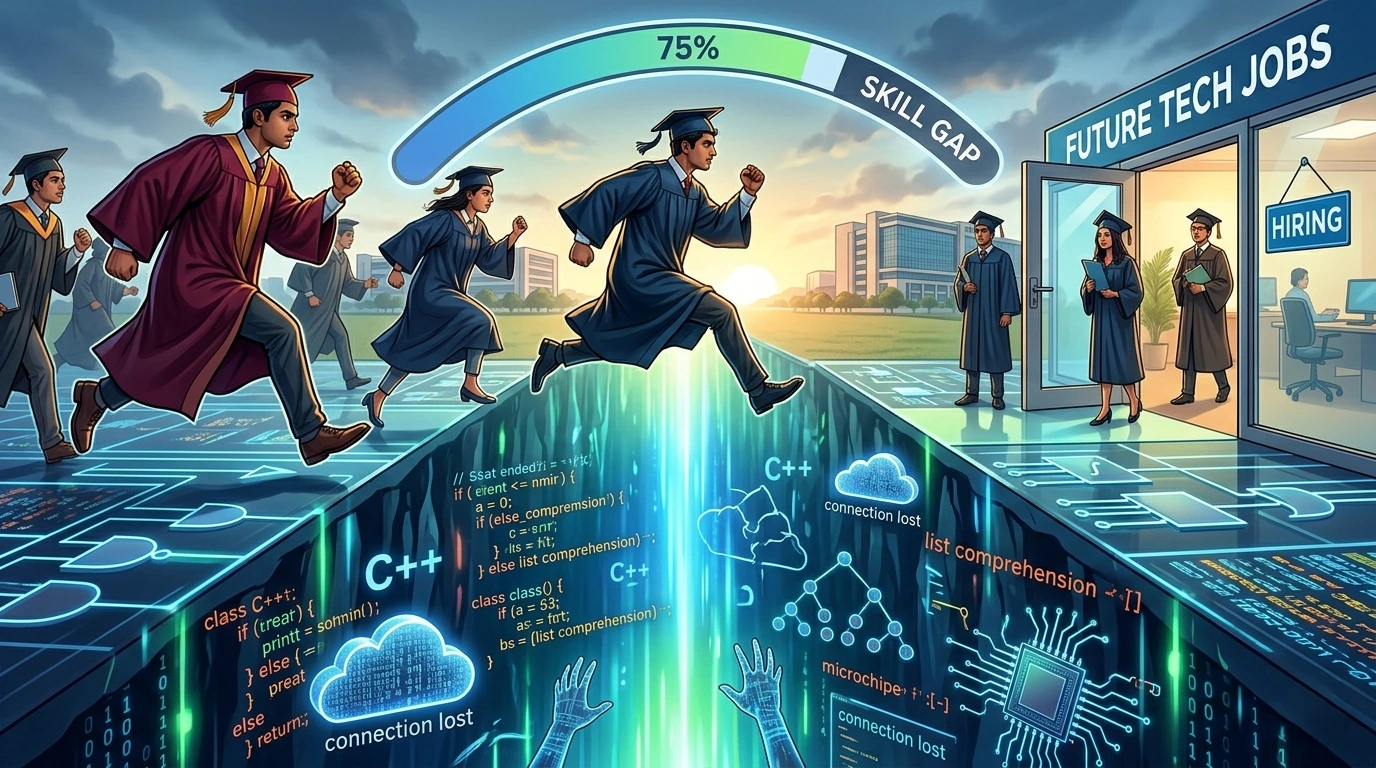
A skill gap between academic learning and workplace expectations is one reason employers increasingly evaluate practical ability alongside degrees.
Skills over degree means employers judge job capability first and academic background second.
Skills-first hiring: checks what a candidate can build, not just where they studied.
Competency-based hiring: measures specific abilities against the exact job requirement.
Portfolio-driven recruitment: reviews real projects instead of transcripts.
Practical assessments: test coding, problem-solving, and tool usage directly.
A degree builds theory. Skills prove execution.
Common ways recruiters verify skills today:
Reviewing a GitHub portfolio
Checking certifications from Coursera or AWS Skill Builder
Assigning a small coding assessment or live project
Requesting a capstone project during final interview rounds
Weighing internship experience as a signal of job readiness
Three forces are driving the shift toward skills based hiring across the IT industry.
Technology moves faster than most college syllabi can update, so employers look for candidates trained on current tools. Students looking to build industry-relevant skills can choose structured programs that combine technical fundamentals with practical tools and projects.
Artificial Intelligence, Cloud Computing, and Cybersecurity change year on year.
Most college curricula take years to update.
Tools like Docker, Kubernetes, and Git evolve faster than textbooks can track.
A graduate trained on outdated frameworks needs retraining before contributing to live projects.
This gap is a core reason employers choose skills over degree during shortlisting.
Software teams run on Agile and Scrum cycles with tight sprint timelines.
A new hire with a long onboarding period slows the whole team down.
Job ready skills cut the time between hiring day and first real contribution.
Internship or live-project exposure shortens this ramp-up period significantly.
Interviewers now use scenario-based questions to test workplace readiness directly.
Live coding challenges on HackerRank and LeetCode test ability in real time.
GitHub repositories reveal commit history and project quality.
Stack Overflow activity can show a candidate's problem-solving pattern.
LinkedIn now displays skill endorsements and certification badges.
Project-based hiring removes guesswork that a resume alone cannot resolve.
Companies like Accenture and Infosys have shortened hiring cycles using these tools.
Employers evaluate technical ability and professional behavior side by side.
|
Skill |
Why Employers Value It |
|
Technical Skills |
Immediate productivity |
|
Problem Solving |
Solves business challenges |
|
Communication |
Improves team collaboration |
|
Adaptability |
Speeds up learning new technologies |
|
Critical Thinking |
Supports better decision-making |
|
Teamwork |
Strengthens Agile project delivery |
Tools and technologies recruiters check most often:
Git and SQL as baseline requirements for most developer roles
Python and Java as the most in-demand programming languages
React for front-end roles at companies like Amazon and Cognizant
AWS experience for cloud-focused positions
Agile and DevOps knowledge for modern delivery teams
Employability skills combine this technical ability with workplace behavior into one hiring decision.
|
Degree |
Skills |
|
Theoretical foundation |
Practical execution |
|
Academic knowledge |
Real-world application |
|
Long-term education |
Immediate productivity |
|
Opens opportunities |
Wins interviews |
A degree opens the door to certain applicant pools. Skills win the actual interview and the job offer. Career growth is fastest for candidates who combine both.
Myth: Degrees are useless.
Reality: Degrees still build strong theoretical foundations. Companies like IBM and Microsoft continue to value formal education for research and core engineering roles.
Myth: Certifications guarantee jobs.
Reality: Practical experience and real-world projects often carry greater value than a certificate alone. A Google Cloud Skills Boost certification helps only when paired with a working project.
Myth: Only programmers need portfolios.
Reality: Portfolios help developers, designers, analysts, testers, and data professionals alike. A data analyst can show a Power BI dashboard. A tester can show a documented test case suite.
Learn industry tools - Git for version control, AWS or Google Cloud for cloud basics, Docker for containerization.
Build real projects - host every project on GitHub and link each one to a live demo.
Gain practical exposure - internships, open-source contributions, and freelance work.
Earn relevant certifications - AWS, Google Cloud, Microsoft Learn, freeCodeCamp, and Coursera.
Practice technical interviews - daily problem-solving on LeetCode and HackerRank, plus mock interviews.
Structured training programs close the gap between classroom learning and daily job tasks.
Live projects give hands-on exposure to real coding problems.
Mentorship helps learners fix mistakes early instead of repeating them.
Coverage of Full Stack Development, Python, Java, and Data Science builds job-specific ability.
Placement assistance and interview preparation add value beyond the technical curriculum.
This structure signals job readiness to recruiters before the first interview round.
Employers increasingly evaluate practical skills alongside academic qualifications.
Degrees provide a foundation, but real-world capability improves employability.
Portfolios, internships, and technical assessments demonstrate job readiness.
Continuous learning is essential because technology evolves rapidly.
Combining education with practical experience creates stronger career opportunities.
Does skills matter more than degree?
Skills often have a greater impact on hiring for practical IT roles because they show what you can do. However, many employers consider both your skills and educational background when making a decision.
Do You Need a Degree to Build a Career in IT?
Yes. Many companies hire candidates without a degree if they can demonstrate strong technical skills through projects, certifications, or a coding portfolio.
What are employability skills?
Employability skills are the practical abilities that help you perform effectively in a professional work environment. They include communication, teamwork, problem-solving, adaptability, and technical competence.
What are job-ready skills?
Job-ready skills are the practical abilities needed to perform effectively from the beginning of a role. They may include coding, version control, database knowledge, cloud fundamentals, and collaboration skills.
Why do companies use skills-based hiring?
Companies use skills-based hiring to identify candidates who can perform the required tasks effectively. It helps employers find talent based on proven ability rather than qualifications alone.
How do I become job-ready?
Gain practical experience by building projects, learning industry-relevant tools, earning certifications, and practicing interview skills. Real-world experience through internships or open-source work can also strengthen your profile.
The IT hiring landscape is changing, not because degrees have lost value, but because employers need professionals who can contribute from day one. Academic education builds foundational knowledge. Projects, internships, certifications, and continuous learning demonstrate the practical ability required in today's workplace.
If you want to build real, job ready skills through live projects, mentorship, and placement support, QIS Academy's software training programs can help you get there.

Posted On 04-09-2026

Posted On 04-09-2026

Posted On 10-08-2026

Posted On 16-07-2026
Posted On 22-05-2026

Posted On 21-01-2026